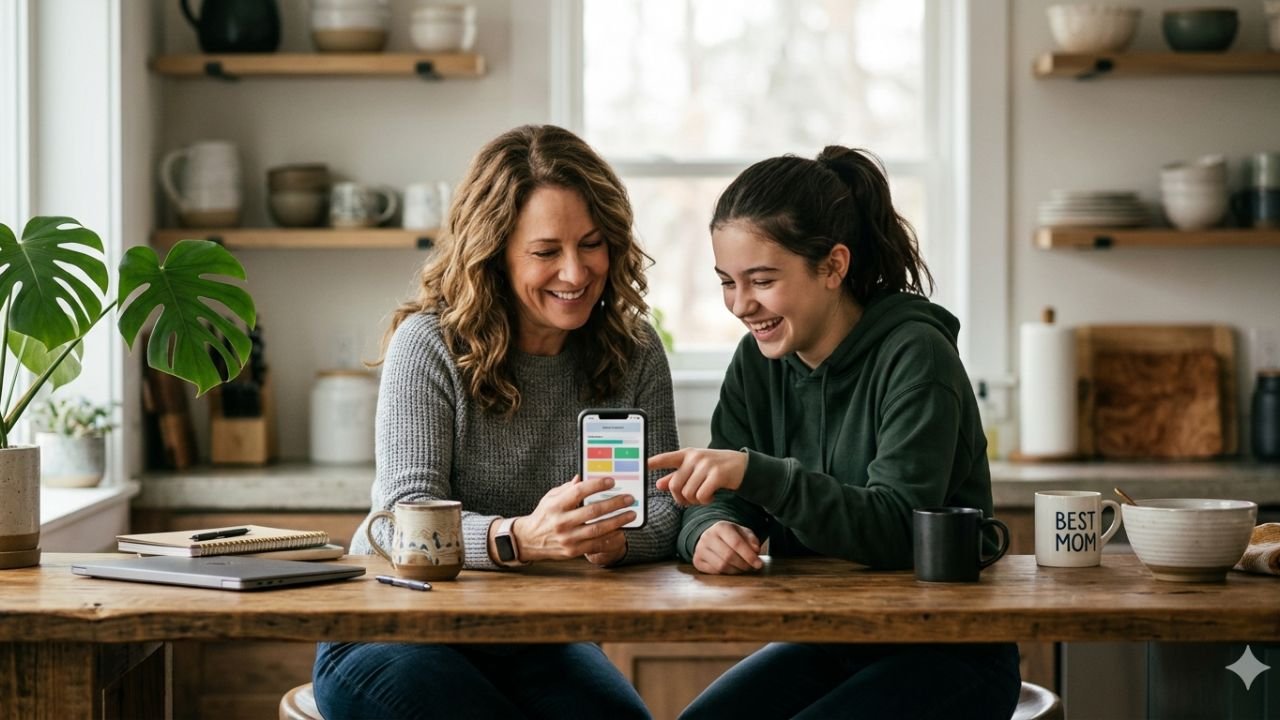
So your teenager comes home from school giggling with their friends about something called the “Rice Purity Test.” Or maybe you spotted it on their phone screen before they quickly flipped it over. Either way, you’re probably sitting there wondering what this thing even is. Is it dangerous? Should I be worried?
Take a breath. You’re not alone, and you’re not overreacting for asking questions.
The Rice Purity Test has been floating around the internet for decades, and it’s had a serious comeback in recent years thanks to TikTok, Reddit, and teen social media culture. Millions of young people have taken it. But that doesn’t automatically make it safe, especially for younger teens.
In this post, we’re going to break it all down honestly. What the test actually is, what privacy risks it carries, why age really matters here, and what parents can do to have a real, non-awkward conversation with their kids about it. No fear-mongering. No lecture mode. Just facts and practical guidance.
Let’s get into it.
What Is the Rice Purity Test, Anyway?
The Rice Purity Test is a self-graded questionnaire that originated at Rice University back in the 1980s. It was originally designed as a fun, lighthearted way for college freshmen to bond with each other and reflect on their life experiences.
The test contains 100 questions that cover a wide range of experience,s from things as innocent as “held hands romantically” to questions about alcohol, drugs, and sexual activity. You answer yes or no to each one, and at the end, you get a score out of 100.
A higher score means you’ve experienced fewer of the things on the list (considered “more pure”), and a lower score means you’ve done more of them.
Here’s the thing, though: it was made for college students. Adults. People who were 18 or older and presumably had some life experience and emotional maturity to put the questions in context.
Today? Middle schoolers are taking it. Twelve and thirteen-year-olds are comparing scores with their friends at lunch. And that changes the conversation entirely.
Why Is the Rice Purity Test So Popular Right Now?
If you’re wondering why something from the 1980s is suddenly everywhere, it’s social media.
TikTok creators started posting their scores and reactions, turning it into a viral trend. Teens began challenging each other to take it. It became a weird kind of social currency, a way to seem cool, experienced, or relatable.
Here’s why it spread so fast:
- It’s framed as harmless fun. It looks like a quiz, and teens love quizzes.
- It creates social bonding. Comparing scores gives people something to talk about.
- It involves a little bit of rebellion. The questions feel edgy, which teens naturally gravitate toward.
- It’s anonymous or at least it feels that way.
That last point is where things get a little tricky. And we’ll get to it shortly.
Is the Rice Purity Test Actually Safe?
Here’s the honest answer: it depends on who’s taking it and how.
For a 20-year-old college student taking it for laughs with their dormmates? Probably fine. The original intention was pretty harmless.
For a 13-year-old being pressured by peers to compare scores? That’s a different story.
Let’s look at the real concerns.
The Age Problem: It Was Never Designed for Kids
This is the big one. The Rice Purity Test asks about experiences that are completely age-inappropriate for preteens and young teenagers. We’re talking about questions involving sexual activity, drug use, and other adult behaviors.
When a 12 or 13-year-old reads these questions, a few things can happen:
- Normalisation of adult behaviors. If a test is framing these experiences as something everyone eventually does, young minds might start to see them as a rite of passage rather than choices with consequences.
- Pressure to “lower” their score. There’s an unfortunate social dynamic where a lower score is seen as cooler or more interesting. This can make some teens feel like they need to rush into experiences just to fit in.
- Confusion and anxiety. Younger kids who haven’t encountered these topics before might feel anxious, embarrassed, or confused reading certain questions, especially without a trusted adult to talk to.
Real talk: if your 12-year-old came home with a book that asked detailed questions about drug use and sexual experiences, you’d probably have a problem with it. The test is no different just because it’s on a screen.
Privacy Concerns: Is Your Data Actually Safe?
This is the part that most parents, and honestly, most teens, don’t think about.
When you take the Rice Purity Test online, you’re usually visiting a third-party website. Some of these sites are straightforward and don’t collect much. Others? Not so transparent.
Here’s what could potentially be happening in the background:
Data Collection Many websites collect basic user data — your IP address, location, device type, browser information, and how long you spend on the page. Even if the test feels anonymous, your visit is being tracked in some form.
No Age Verification:n There is zero age verification on most Rice Purity Test sites. Anyone of any age can access the content instantly.
Third-Party Cookies and Trackers Some sites run advertising networks or analytics tools that plant cookies on your device. This data can be sold or shared with advertisers.
Screenshots and Social Sharing Once a teen posts their score or shares a screenshot, that information is out there. What felt like a private moment between friends can spread fast on social media.
The test itself isn’t stealing your identity or anything dramatic like that. But the privacy picture is messier than most teens realize.
The Peer Pressure Angle
Let’s talk about something real: peer pressure is baked into how the Rice Purity Test is used socially.
When teens compare scores, there’s an implicit judgment happening. The “lower” your score, the more experiences you’ve had. And in certain social circles, that gets treated as something to brag about.
This creates a subtle but real pressure on teenagers, especially insecure ones, to either lie about their score or actually pursue risky behaviors to “keep up.”
A 2021 study on adolescent social media behavior found that teens regularly engage in online activities that feel low-stakes but carry hidden risks when peer dynamics are involved. The Rice Purity Test fits that pattern.
It’s not the test itself that’s dangerous. It’s what happens when social comparison gets tangled up with questions about sex, drugs, and risky behavior.
What Parents Should Know: A Practical Guide
Okay, so now that we’ve laid out the concerns, what do you actually do with this information? Here’s practical, real-world guidance.
Don’t Panic, But Don’t Ignore It Either
If your teen has already taken the test, don’t make it a bigger deal than it needs to be. Coming down too hard will just make them shut down and hide things from you in the future.
But definitely don’t ignore it either. This is actually a golden opportunity for an open conversation.
How to Bring It Up Without Awkwardness
Nobody wants to sit through a lecture. Here’s how to approach it:
- Start with curiosity, not judgment. “Hey, I heard about this Rice Purity Test thing. What’s the deal with it? What do your friends think about it?”
- Share your concerns calmly. Once they’re talking, you can gently mention what you learned about the age-appropriateness of the content, the social pressure angle, and the privacy stuff.
- Ask open-ended questions. “Did it feel weird answering some of those questions?” or “Did anyone pressure you into comparing scores?”
- Listen more than you talk. The goal isn’t to deliver a verdict. It’s to understand what your kid is experiencing and make sure they know they can come to you.
Talk About Peer Pressure Specifically
Use this as a launchpad to talk about how social comparison works, not just with this test, but in general.
Some questions worth exploring with your teen:
- Why do you think people share their scores online?
- Does a lower score actually make someone cooler or more interesting?
- Have you ever felt pressured to do something because it seemed like “everyone else” was doing it?
You don’t need all the answers. Just having the conversation matters enormously.
Check Privacy Settings Together
Make this a non-confrontational activity. Sit down together and look at what apps and websites your teen uses regularly. Talk about:
- What information websites collect
- Why it matters who can see your activity online
- How to read a basic privacy policy (even just the highlights)
Making digital privacy a normal dinner-table topic is one of the best things you can do as a parent in 2024 and beyond.
Set Clear Expectations Without Being Controlling
There’s a difference between “You’re never allowed to take any online quiz ever” (which they’ll just do secretly) and “I want you to think critically about the content you engage with online” (which actually teaches something).
Trust your teen enough to talk with them, not at them. That approach goes a long way.
Red Flags to Watch For
While the Rice Purity Test itself isn’t inherently malicious, there are some behaviors worth paying attention to:
- Your teen seems anxious or upset after comparing scores with friends
- They start asking questions about risky behaviors they hadn’t shown interest in before
- You notice a sudden change in their social circle or behavior patterns
- They become secretive or defensive about their phone or online activity in new ways
Any one of these isn’t necessarily alarming on its own. But patterns matter. Trust your gut as a parent.
Frequently Asked Questions
Is the Rice Purity Test illegal?
No, the Rice Purity Test is not illegal. It’s a privately run online quiz. However, the content is inappropriate for minors, and some versions of the site may not be compliant with child data protection laws like COPPA in the US.
Can taking the Rice Purity Test actually harm my child?
The test itself is words on a screen. But the social dynamics around it, comparison, pressure, and embarrassment, can have real emotional effects on younger teens. The bigger risks are indirect: normalization of adult behaviors and peer pressure to engage in them.
My teen has already taken the test. What do I do now?
Don’t overreact. Have a calm, curious conversation. Ask what they thought of it, whether any questions made them uncomfortable, and whether their friends talked about their scores. Use it as an opening, not a confrontation.
Are there privacy risks I should actually be worried about?
The risk isn’t identity theft. But most Rice Purity Test sites do collect some form of user data, and there’s no age verification. Encouraging your teen to use privacy-focused browser settings and think critically before visiting unfamiliar sites is always a good habit.
What’s a good age to have “the talk” about online content like this?
Honestly? Earlier than you think. By the time kids are 10 or 11, they’re often already encountering this type of content through friends. Age-appropriate conversations about peer pressure, online privacy, and body autonomy can start even earlier in simplified forms.
Conclusion
At the end of the day, the Rice Purity Test is a symptom of a much bigger reality: our kids are growing up online, surrounded by content that wasn’t designed with their age or emotional development in mind.
You can’t bubble-wrap them from every quiz, trend, or viral moment. And honestly, trying to do that usually backfires.
What you can do is be the kind of parent your teen actually talks to. The kind who doesn’t immediately freak out when something uncomfortable comes up. The kind who asks questions and actually listens to the answers.
The Rice Purity Test might have started a decade before the internet existed, but the questions it raises about peer pressure, identity, privacy, and growing up are as current as ever.
So use it. Use it as the conversation starter it accidentally is. Because a teenager who knows they can talk to their parent about something as awkward as a “purity test” is a teenager who’ll come to you when something actually serious happens.
And that? That’s the whole game.