Let’s be honest. At some point, someone in your friend group sent you a link with the message: “Take this test and tell me your score!” And you either took it immediately, or you got curious and started Googling. Either way, here you are.
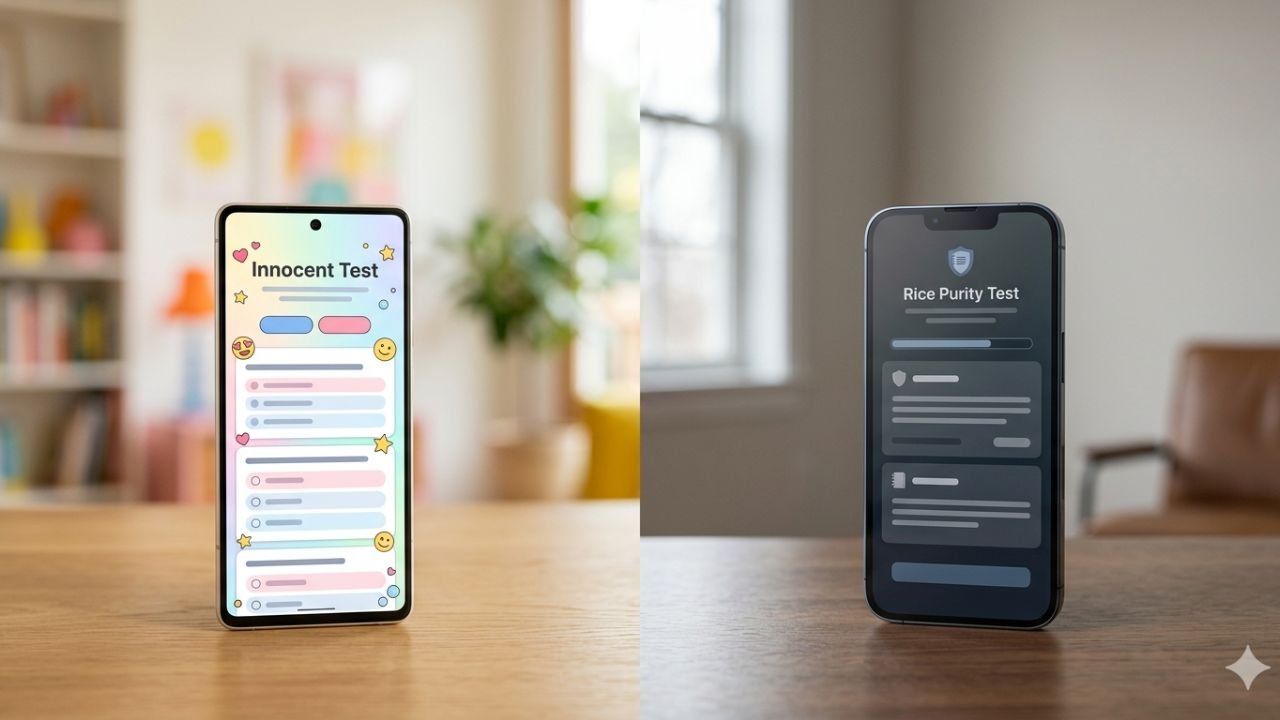
The Innocent Test and the Rice Purity Test are two of the most talked-about online quizzes in teen and young adult circles right now. They sound similar. They feel similar. But they’re actually quite different in purpose, in tone, and in who they’re really designed for.
In this post, we’re going to break everything down in plain, simple English. No judgment. No lectures. Just honest, clear information so you know exactly what you’re dealing with before you click “start.”
First, Let’s Talk About the Rice Purity Test
What Is the Rice Purity Test?
The Rice Purity Test has been around since the 1980s. It was created by Rice University in Houston, Texas, as a way for incoming college freshmen to bond with each other. Think of it as an icebreaker, something fun to compare scores with your new dorm roommates.
The original test has 100 questions. Each question asks whether you’ve done something or experienced something in your life. You check the boxes for things you’ve done, and your final score is calculated out of 100.
The lower your score, the more “experienced” you’re considered. The higher your score, the more “innocent” you are, at least according to the test.
What Kind of Questions Does It Ask?
The Rice Purity Test covers a wide range of experiences, including:
- Holding hands with someone romantically
- Going on a date
- Drinking alcohol
- Trying recreational substances
- Sexual experiences of various kinds
- Getting in trouble with the law
- Skipping school or work
Some questions are very mild and relatable. Others are more mature and adult in nature. That’s one of the key things to know upfront: the Rice Purity Test includes explicit content and is generally considered more appropriate for adults or older college students.
Who Takes the Rice Purity Test?
The Rice Purity Test became wildly popular on social media, especially on TikTok and Twitter/X, where people started sharing their scores publicly. College students, young adults, and even some teenagers have taken it out of curiosity.
The average score reportedly falls somewhere between 55 and 75, but honestly, the “average” doesn’t matter as much as people think. It’s not a competition, or at least, it shouldn’t be.
Now, Let’s Talk About the Innocent Test
What Is the Innocent Test?
The Innocent Test is a newer, lighter alternative to the Rice Purity Test. It was created with a younger, more general audience in mind. Where the Rice Purity Test can get quite heavy and adult-themed, the Innocent Test tends to stay in much safer, friendlier territory.
Think of it like this: if the Rice Purity Test is a college party game, the Innocent Test is more like a sleepover quiz you’d pass around with your friends in high school or even middle school.
The Innocent Test focuses on everyday life experiences that most people can relate to without things getting uncomfortable or inappropriate.
What Kind of Questions Does It Ask?
The Innocent Test typically includes questions like:
- Have you ever snuck food into a movie theater?
- Have you ever lied to get out of school?
- Have you ever stayed up past midnight on a school night?
- Have you ever had a crush on a teacher (from afar, obviously)?
- Have you ever cheated on a test?
- Have you ever pretended to be sick to avoid something?
See the difference? These are things almost everyone can laugh about and relate to. There’s no pressure, no awkwardness, and no content that would make someone feel uncomfortable taking it in public.
Who Takes the Innocent Test?
The Innocent Test is popular among teenagers, younger students, and really anyone who wants a fun, lighthearted quiz experience. It’s the kind of test you take at a slumber party, share in a group chat, or use as a conversation starter with new friends.
It’s also a great option for people who found the Rice Purity Test a little too intense but still wanted something fun to engage with.
Innocent Test vs. Rice Purity Test: A Side-by-Side Comparison
Let’s lay it all out so you can see the differences clearly.
1. Origin and History
Rice Purity Test: Created in the 1980s at Rice University. Decades of history behind it. Started as a bonding activity for college freshmen.
Innocent Test: A modern creation, designed more recently as a friendlier, more inclusive alternative. No specific university ties.
2. Target Audience
Rice Purity Test: College students and adults, generally 18+. Some content is explicitly adult-oriented.
Innocent Test: Teenagers and young adults. Content stays appropriate for a broader age range.
3. Types of Questions
Rice Purity Test: Covers a wide spectrum from innocent first dates all the way to mature experiences most adults recognize.
Innocent Test: Focuses on relatable everyday situations, school life, social moments, harmless mischief, and general teenage experiences.
4. Tone
Rice Purity Test: Can feel serious or even anxiety-inducing for some people, especially younger users who feel pressure about their score.
Innocent Test: Light, fun, and judgment-free. Most people finish it laughing or feeling nostalgic.
5. Scoring
Rice Purity Test: Scored out of 100. Lower = more “experienced.” Higher = more “innocent.”
Innocent Test: Also often scored numerically, but the focus is more on fun than ranking. It’s less about where you fall on a scale and more about the experience of taking it.
6. Social Media Presence
Both tests are popular online, but in different spaces. The Rice Purity Test tends to trend among college-age TikTokers and Reddit communities. The Innocent Test is more likely to circulate in school group chats and younger social media spaces.
Why Do People Take These Tests in the First Place?
Great question. And the honest answer is mostly for fun.
But there’s more to it than that. These quizzes tap into something deeply human: the desire to understand ourselves and compare our experiences with others. We want to know, “Am I normal? Have I done more or less than my friends? What does my score say about me?”
Here’s the thing, though, your score doesn’t define you. Not even a little bit.
Taking the Rice Purity Test with a 40 doesn’t make you a bad person. Scoring a 95 on the Innocent Test doesn’t make you boring. These are just snapshots of experiences, and life is so much more complex than a checklist.
People also take these tests as a way to open conversations. Maybe you and your best friend take it together and end up sharing stories and laughing for an hour. That’s the real value of the connection, not the number.
Practical Tips Before You Take Either Test
If you’re thinking about taking one of these quizzes, here are a few things to keep in mind:
- Know your audience. If you’re younger or sharing the test with younger friends, the Innocent Test is the safer, more appropriate choice. Save the Rice Purity Test for when you’re older and in the right social setting.
- Don’t let your score define you. Seriously. It’s a quiz on the internet. It doesn’t measure your worth, your intelligence, your character, or your future. Take it for fun, not for validation.
- Never pressure anyone to share their score. These quizzes can get personal. If a friend doesn’t want to share their result, that’s completely okay. Respect boundaries.
- Be aware of your emotional state. If certain questions make you feel uncomfortable or bring up difficult feelings, it’s completely okay to stop. No quiz is worth your mental peace.
- Context matters. Taking the Rice Purity Test at a college party with your friends is a very different experience from stumbling upon it alone at 2 AM. Set the right context for yourself.
Frequently Asked Questions
Is the Rice Purity Test appropriate for teenagers?
Honestly? Some of it is fine, but parts of it are definitely adult-oriented. If you’re a teenager or sharing it with younger friends, the Innocent Test is a much better fit. It covers similar “have you ever” territory without crossing into content that isn’t age-appropriate.
Is there a “good” or “bad” score on either test?
No. There is no good or bad score. A high score doesn’t make you better than someone with a low score, and vice versa. The whole point is to have fun and maybe spark some interesting conversations, not to rank people by their life experiences.
Can taking these tests affect my privacy?
Good question. Most versions of these tests are simple web-based quizzes that don’t require you to log in or share personal data. However, be cautious about which websites you use. Stick to well-known, reputable versions and avoid any site that asks for your name, email, or personal information just to show you a quiz result.
What’s the average score on each test?
For the Rice Purity Test, the commonly cited average is somewhere around 55–77, depending on age group and community. For the Innocent Test, since it’s lighter and covers less intense territory, scores tend to be higher on average. But again, averages are just averages. Your personal score is your own.
Are there other tests like these?
Yes, quite a few. There are various spin-offs, themed versions (like the “Fandom Purity Test” or “Nerd Purity Test”), and other personality-style quizzes that follow a similar format. If you enjoy this kind of thing, there’s a whole world of harmless personality quizzes out there to explore.
Conclusion
One thing worth addressing is the social pressure that can sometimes come with these quizzes. When scores go viral, or people start comparing numbers in group chats, it can create a weird kind of competition.
“Wow, your score is so high, you’re so innocent!” “Your score is way lower than mine, you’ve done so much more than me!”
Both of those statements can sting, depending on who hears them and how they’re said. The person with the “high innocent score” might feel judged for being inexperienced. The person with the lower score might feel embarrassed or pressured.
The bottom line: use these quizzes to connect, not to compare. Use them to laugh together, share stories, and bond, not to rank each other.